Building a Record Collection: 1975 - Another Green World thru Blood on the Tracks
Brian Eno, Azymuth, Bob Dylan, The Band, and Billy Harper
I’m building my dream record collection. Thirty albums from each year between 1960 and 2020. Five albums per post, one year per month, a round-up of other notable records before I move on to the next. I want to build a personal music collection like a small library of modern art, one in which the album is the medium. You can read my complete thinking here, including links to other entries. No one’s musical knowledge is complete, and neither is mine. Please point out my massive gaps in the comment section!

The year is 1975. The Sex Pistols play their first concert at the St. Martin’s School of Art. Talking Heads play their first show at CBGB. The first issue of Punk magazine is released with a drawing of Lou Reed on the cover; the Ramones sign to Sire Records. The Wiz opens on Broadway. The films Tommy and The Rocky Horror Picture Show premiere. The Jackson 5 leave Motown for CBS. Charlie Rich lights the piece of paper on fire announcing John Denver as the Country Music Awards Entertainer of the Year after opening the envelope on stage. Bernard Herrmann dies from an apparent heart attack the day after he finishes recording the soundtrack to Taxi Driver. Umm Kulthum’s funeral procession attracts 4 million observers. T-Bone Walker and Cannonball Adderley succumb to strokes; Bob Wills dies of pneumonia; Tim Buckley overdoses. Josephine Baker is found comatose in her bed, having suffered a cerebral hemorrhage, surrounded by newspapers acclaiming her performance at a 50-year career retrospective a few days prior.
See all of the 1970s selections
See all selections listed by artist

1975
Part 1
Listed alphabetically by album title
Eno - Another Green World (Island)
art pop
Eno refines his artistic approach. He is floating away from traditional song structure, a realization that mood can be as powerful as narrative. It supposedly comes from being trapped in a hospital room with a record of 18th-century harp music for company. Eno pairs this epiphany with his love of process: the making of the art is as important, if not more, than the actual piece of art produced. So he enters the studio without a plan and the pack of prompting Oblique Strategies cards he recently developed (a few random examples: Use ‘unqualified’ people; Use an unacceptable color; Don’t be frightened to display your talents; Faced with a choice, do both). The process isn’t an easy one—as his frustrated collaborators attest, Phil Collins, John Cale, and Robert Fripp among them—but it results in something quite new in the world of art rock. Another Green World is a collection of brilliantly textured mood pieces that you must traverse to get to the more traditional pop songs, which of course are pleasantly oddball coming out of Eno’s brain. Tunes like “St. Elmo’s Fire” and “I’ll Come Running,” for example, are bridged by the psychedelic Western sonic landscape of “In Dark Trees” and the blooming accordion dream sequence of “The Big Ship.” Taken as a suite of songs, it lets the listener conjure their own internal narratives in between the already impressionistic lyrical tracks. It is timbre and tone as emotional pedals. It is a clearing in Eno’s path toward ambient music.
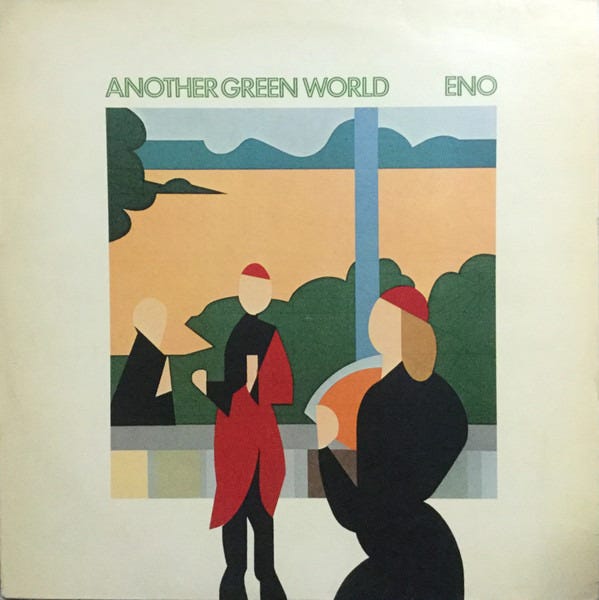
The album cover is a zoomed-in portion of Tom Phillips 1973 screenprint After Raphael. Like Eno, Phillips is a lover of conceptual art and is best known for A Humument: A Treated Victorian Novel, a piece created on top of a randomly selected novel. Completely appropriate to the music, Phillips uses his love of the 15th century painting Votive Picture as a creative exercise, imposing a geometrical system on top of a non-geometrical work. An appropriate image if there ever was one.
Azymuth - Azimüth (Som Livre)
samba doido
The future of jazz-funk is Brazilian. The trio of José Roberto Bertrami, Alex Malheiros, and Ivan Conti are bouncing around the Copacabana for years as session musicians by the time they decide to become a standalone trio, inspired by their sensational work on Marcos Valle’s Previsão Do Tempo. Samba may be the blood that enlivens their shared circulatory system—a band just can’t be as tight as Azymuth without being biologically connected—but it is a love of funk, jazz, MPB, and fusion that sets them apart from their peers. Named after a Valle song (of which they later change the spelling to “Azymuth”), Bertrami, Malheiros, and Conti produce a lithe funk that sounds like the Crusaders doused in caipirinhas and sunscreen. This album, their debut, is an eel of a record, slick and slender, predatory in its ability to get your feet moving with currents of electric disco-soul. The boys are deceptively strong songwriters as well. While the grooves may be what catches your immediate attention, the tracks utilize psychedelic effects, jazzy improv, and post-tropicália pop sounds to create dramatic energy. There is a clear intelligence to each song’s build, even if the trio is using all that brainpower simply to soundtrack your night dancing on the beach. Jazz-funk never sounded so well-tanned.
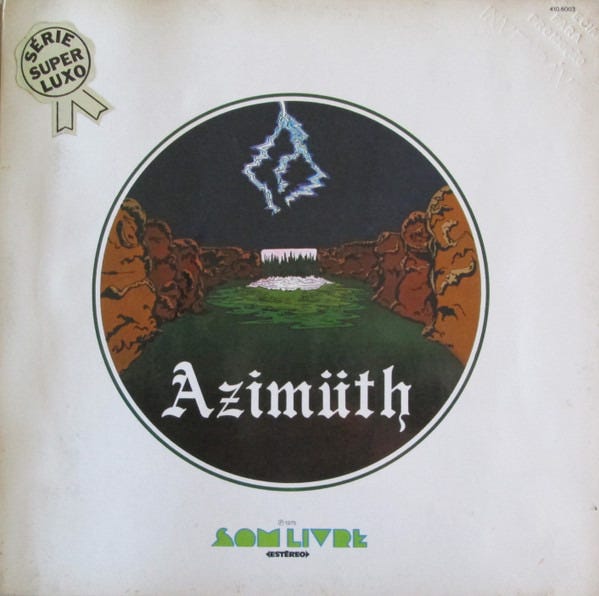
Between the umlaut and the cover painting, I wouldn’t blame you at all for mistaking this record for a prog-metal atrocity. Labels try time and again to better this on each subsequent reissue, but I think those all fail as well. Curious why no one can get this right visually.
Bob Dylan / The Band - The Basement Tapes (Columbia)
Americana rock
The bootlegs become official. The well-told story of how these recordings come to be starts with Dylan’s motorcycle accident in July 1966, right at the top of his game, Blonde on Blonde released the month before. It derails his momentum, but it creates time away from the increasingly large crowds to reconsider this new life as a pop star. And, of course, to write songs. Holed up in Woodstock, NY, Dylan invites his backing band—the boys that soon become the Band—to jam and, importantly, reengage with traditional American music during the psychedelic Summer of Love. They eventually move over to the basement of Rick Danko’s “Big Pink” house and set up a homespun recording unit. The intimacy of the recording space, the rural setting, the lack of onlookers for the first time in years, it all leads to a decompressing Dylan, relaxed and having fun with his friends’ love of blues, rockabilly, and R&B. The recordings begin to circulate soon after and the Band record their own great Music from Big Pink, refining a number of these collaborations. The official release, however, doesn’t happen until 1975, and it is a bit of a Frankenstein’s monster: remixes of some of the recordings, overdubbed expansions of others, a slew of studio outtakes from the Band not associated with the actual basement in question but spiritually similar in tone. Despite the perhaps-questionable compiling, the double-LP is a time warp into a missing period in Dylan’s recorded history. While contemporaries are obsessed with the colorful productions of Sgt. Pepper, Dylan and company are going full sepia, an embrace of soulful country sounds that will become all the rage in the late 60s and beyond. Dylan always sees the future through a prism of the past, and The Basement Tapes is a slightly-varnished window into that psyche.
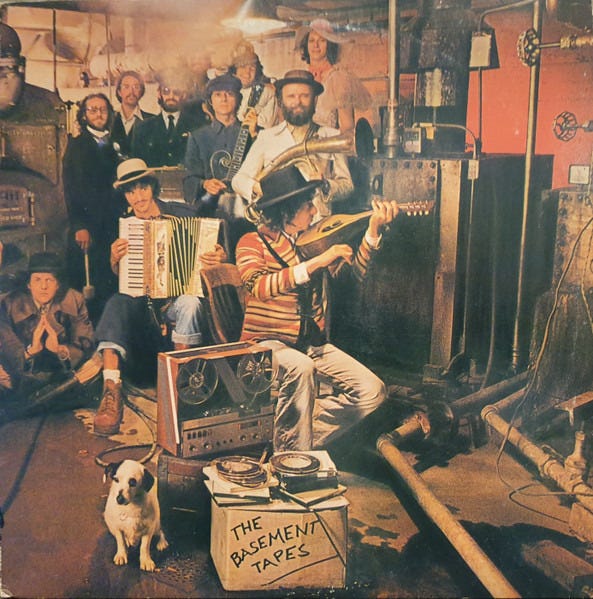
Along with the reconstruction of the past that is the music, the album’s cover is also an artistic take on it. The photograph happens in 1975 rather than 1967, and the art director dresses up its participants in the costumes of the record’s many characters. It is a smirking conceptual piece; it messes with the less-informed listeners even though they have the good taste to pick up the album.
Billy Harper - Black Saint (Black Saint)
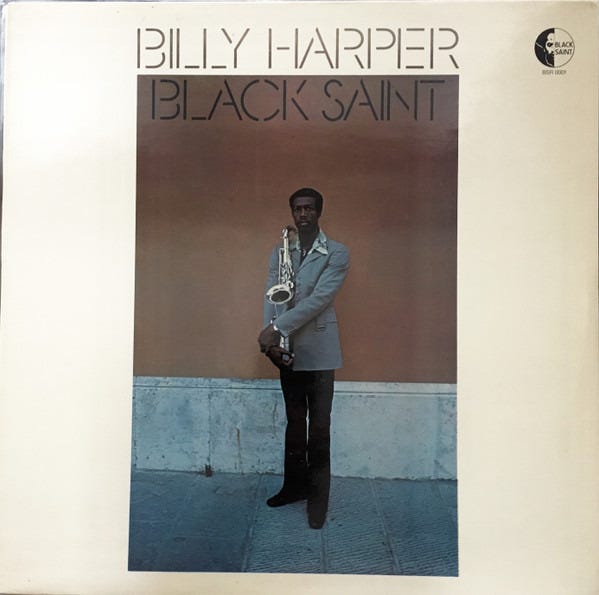
post-bop jazz
The launch of a great jazz label. Black Saint is one of those imprints that should trigger you to head to the cash register even if you don’t know anything else about the LP in your hands. It is fitting that Giacomo Pelliciotti, the Italian founder, both kicked off his venture with this record and stole its name. So many of the label’s eventual roster are descendants of the spirit-exploring, avant-garde jazz pioneered by John Coltrane, who all but entered sainthood by 1975. Harper is certainly an acolyte, a fellow tenor saxophonist who joins Art Blakey’s Jazz Messengers a year after Coltrane’s passing and plays with a number of masters (Louis Armstrong, Max Roach, Gil Evans, Lee Morgan) before striking out on his own with the Strata-East-released Black consciousness classic Capra Black in 1973. Black Saint is a maturing of that record and a self-recognition of his power as an improviser of melodies, both accessible and challenging. Harper is able to use Coltrane’s sheets of sound technique to stretch out and prism hard bop’s gospel feel. “Dance! Dance, Eternal Spirits,” the first track, even begins with Coltrane’s opening run on “In a Sentimental Mood” before it bends down into a bluesy call of emotion. Harper washes away the tenderness of that ballad in order to dig into its more spiritual groove. Trumpeter Virgil Jones makes for a worthwhile partner, and the rhythm section of Joe Bonner, Malcolm Pinson, and David Friesen (shout-out to those stretched bass lines on “Croquet Ballad”) support with aplomb. Black Saint, the label, will certainly get more adventurous than this first release with its discography, but as a mission statement, it doesn’t get much better.
The album cover leaves quite a lot to be desired, but check that early Black Saint logo. That, at least, is a great design.
Bob Dylan - Blood on the Tracks (Columbia)
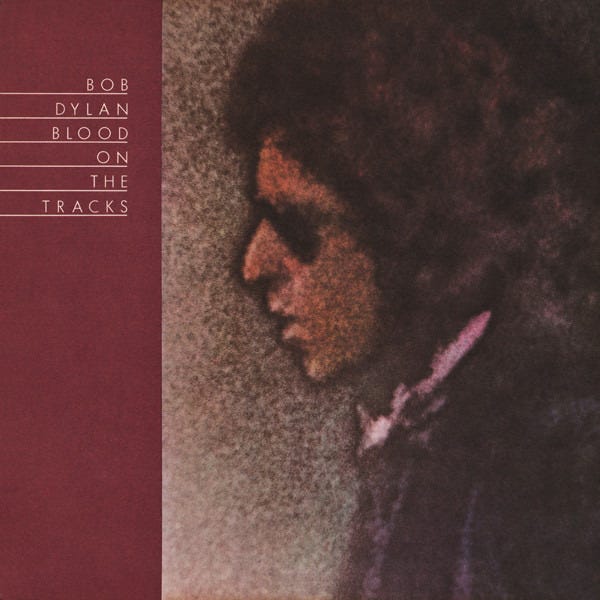
folk-rock
The moods and the songwriting. But Dylan being Dylan, those moods are up for debate, fueled by the songs’ specifics and vagaries, presented in equal weight. Is it autobiographical? Is it storytelling? Is it introverted or extroverted? Breaking up or falling in love? Sure, why not!? It is Dylan after all, and you’d think that by a decade-plus into his rock-as-elevated-culture career, listeners would accept that the ambiguity is as nearly as important as the music. What is known is that Dylan is back with Columbia, and he is returning to a folk-rock sound following a number of discography swerves. Also, his marriage is on the rocks, he has fallen under the tutelage of painter Norman Raeben (“[He] didn’t teach you so much how to draw … he looked into you and told you what you were”), and he is as a pain-in-the-ass in the studio as ever. The first set of sessions in New York end subdued, mostly just Dylan and bassist Tony Brown, the other musicians kicked out when they couldn’t follow Dylan’s spontaneity. Then, at the eleventh hour, Dylan pulls the album to rerecord it in Minnesota with additional instrumentation and spirit. The final tracklisting combines both approaches, making for an album that lacks sonic cohesion: the organ-and-drum energy of “Idiot Wind” vs. the pleasant throwback folk of “Simple Twist of Fate.” It all plays into Dylan’s wonderfully antithetical art. He feels exposed throughout Blood on the Tracks, the closest we’ve gotten to his actual emotional character, but then again, the pronouns are difficult to follow and, of course, he denies it all. What is accepted by all is that the album is a classic. Dylan as only Dylan can Dylan.
The album cover is nowhere as interesting as the music. It is a solarized and watercolored photo of Dylan looking… well, like Dylan. I do appreciate the colors though. The burgundy is a good match for the music, representing a certain maturity mixed with coagulating blood.