Building a Record Collection: 1977 - Aja thru Cheap Trick
Steely Dan, Richard Hell & the Voidoids, Blondie, Black Renaissance, and Cheap Trick
I’m building my dream record collection. Thirty albums from each year between 1960 and 2020. Five albums per post, one year per month, a round-up of other notable records before I move on to the next. I want to build a personal music collection like a small library of modern art, one in which the album is the medium. You can read my complete thinking here, including links to other entries.

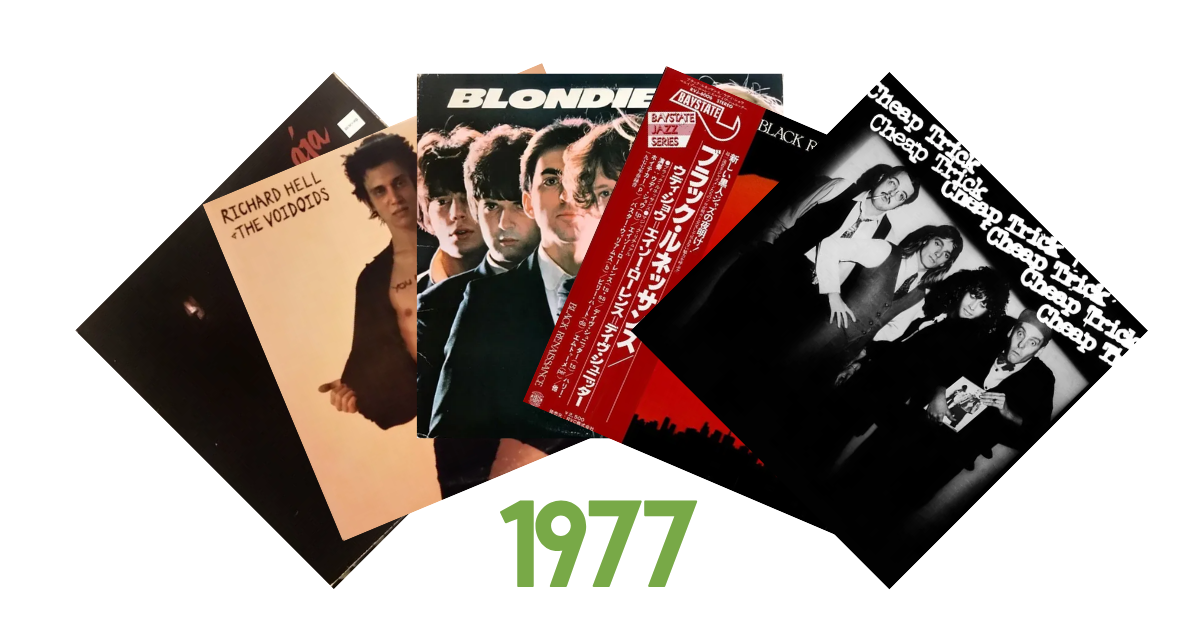
The year is 1977. The Sex Pistols cause all sorts of ruckus, igniting the punk rock movement. Studio 54 opens. Saturday Night Fever premiers, surging disco’s popularity in the United States. Donna Summer’s “I Feel Love” is the first hit record to have an entirely synthesized backing track. NASA launches the golden record into space on the Voyager 2. Ozzy Osbourne quits Black Sabbath. Elvis Presley and Bing Crosby die of heart attacks following notable final performances, including Croby’s duet with David Bowie for the annual TV Christmas special. Lynyrd Skynyrd’s plane crashes in Mississippi, killing Ronnie Van Zant and other members of the band. Paul Desmond succumbs to lung cancer, Erroll Garner and Maria Callas to heart attacks, Rahsaan Roland Kirk to complications following a stroke, and Marc Bolan to injuries caused by a car crash.
See all of the 1970s selections
See all selections listed by artist

1977
Part 1
Listed alphabetically by album title
Steely Dan - Aja (ABC)
jazz-rock
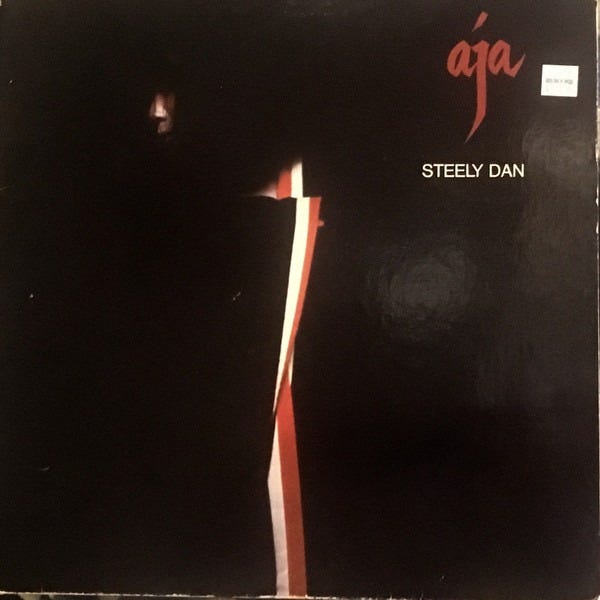
Walter Becker and Donald Fagen realize their studio dream. Aja is a rock record without edges. A jazz record with a backbeat. A pop record with hooks so multi-pronged that once snagged they are impossible to dislodge. It is an album obsessed with the idea of musical perfection, which of course should be anathema to the hip listening public of 1977. But here is the thing, Becker and Fagen kind of achieve it. In the sense, at least, that there is not a note out-of-place, not a chord unconsidered, not a tone unbalanced, not a rhythm uncomplicated. The histories of rock and jazz tells us that this laboratory cleanliness should be rejected; that the emotions the music aims to communicate are human and therefore messy by necessity. The magic is in the charismatic mistakes. But spectrums are indeed circular, and once you reach all the way around to where anarchic punk is taking us, you might just find yourself on the other side of immaculate musicianship. It takes 30 musicians (Wayne Shorter, Bernard Purdie, Larry Carlton, Chuck Rainey, Michael McDonald, and Joe Sample among them) and ABC’s budget, but Becker and Fagen get it done. Snobbery, eye-rolling intellectualism, lyrical absurdities, and chord-nerd referencing be damned, it is near impossible not to be sucked into the album’s pristine surfaces. It is the full realization of what music studio sophistication can produce. And it rocks.
Becker and Fagen are certainly not going to stop with the album art. They choose a truly great photograph, obtuse and alluring, for the jacket photo. They then get ABC to invest in an uber-glossy technique for the printing. For all its excess, it is perfect for the record.
Richard Hell & the Voidoids - Blank Generation (Sire)
art-punk
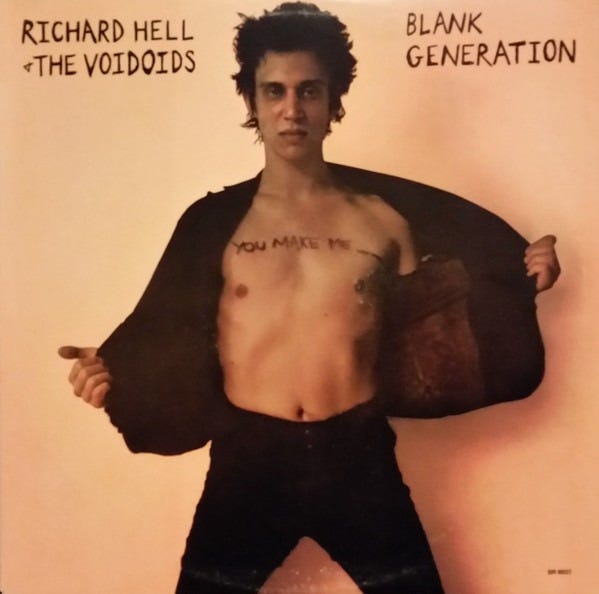
Hell has a pretty good case to make as the originator of the punk aesthetic. He forms the Neon Boys with Tom Verlaine, which evolves into Television in 73/74-ish and is one of the first rock bands to play CBGB. He then catches the attention of Malcolm McClaren, who brings back Hell’s deconstructed, apathetic look to the UK for his next art project, the Sex Pistols. Hell’s own songwriting ambitions bounce him from Television and, subsequently, Johnny Thunders’s Heartbreakers before he puts together the Voidoids, which includes the raw blues-loving, free jazz-appreciating lead guitarist Robert Quine. Together, they find a sweet spot between Patti Smith, the Stooges, Captain Beefheart, and Sonny Sharrock. Equal parts impassioned beat poetry and an angsty tear-down of refined rock music. Hell yelps and yowls (and introduces[?] the oh-oh-ohs of cliche punk on “Liars Beware”) while Quine shreds, less in the virtuosic sense of the word—though he is certainly no slouch—than in the tatter, scrap, strip, and rip meaning. “Blank Generation” may be a forward-looking anthem for the anarchy-loving punks (“I can take it or leave it each time”), but the feeling here is also undeniable. “Betrayal Takes Two,” for example, is proto-emo, and “Another World” is downright romantic (“I could live with you in another world”), if you can find the heart in no wave. The Voidoids are without a doubt punk, but Hell is also an aesthete, and that is a potent combination.
Now that is a face for punk. It is intensely alluring to a certain demographic and completely frightening to another. A simple and effective and thus great album cover from Sire.
Blondie - Blondie (Private Stock)
new wave
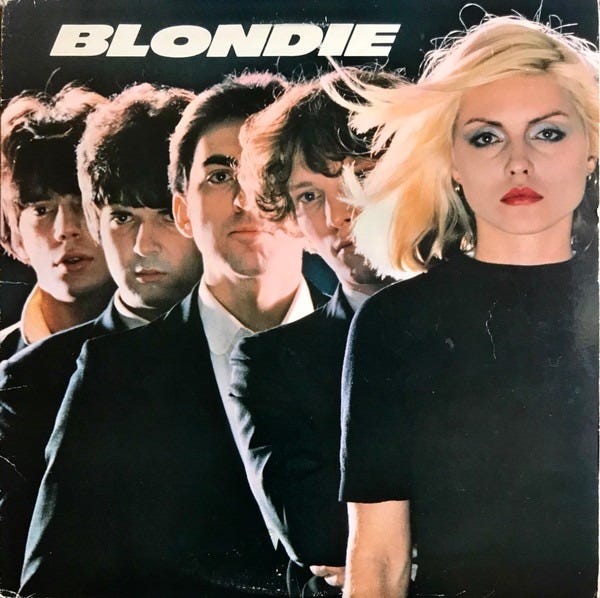
The new wave is retro-chic, irreverent, and platinum blonde. Frontwoman-extraordinaire Debbie Harry and guitarist Chris Stein are mixing and matching bandmates with the CBGB and Max’s Kansas City crowds in the mid-70s, at the moment that the sub-genre terms of new wave, punk, and pub rock begin to find individual definitions rather than being interchangeable terms for “not radio rock.” Blondie starts with an appreciation for girl-group pop, gives it an ironic smirk, strips it down to punk angles, and revs it up with power pop hooks. Their performances catch the eye of the Brill Building songwriters behind “My Boyfriend’s Back,” Richard Gottehrer and Ellie Greenwich, who step in to give this debut record just the right amount of drama and polish. Harry’s voice is made for this moment. It is dynamic without the diva pomp. It has a pop-art quality, mirror-polished, seemingly airy but made of stainless steel, the vocal equivalent of Balloon Dog. The Blondie boys share songwriting duties with Harry, never afraid to toss in a throwback Farfisa riff or an ironic drum fill. The album drips with promise: the lyrical playfulness of “X Offender,” the reggae-pop nods on “Man Overboard,” the vocal hooks of “Look Good in Blue.” The star quality is here from the get-go; Blondie just needs to wait for the radio DJs to catch up with the swelling sounds of underground America. Soon enough they too won’t be able to ignore the new wave of sounds overtaking bloated album rock.
Stein trying to get some camera space from out behind Harry’s attention-demanding hair is such a great image for the album cover. It is a perfect wink of humor to match the band’s sound. Well done by the art director!
Black Renaissance - Body, Mind and Spirit (Baystate)
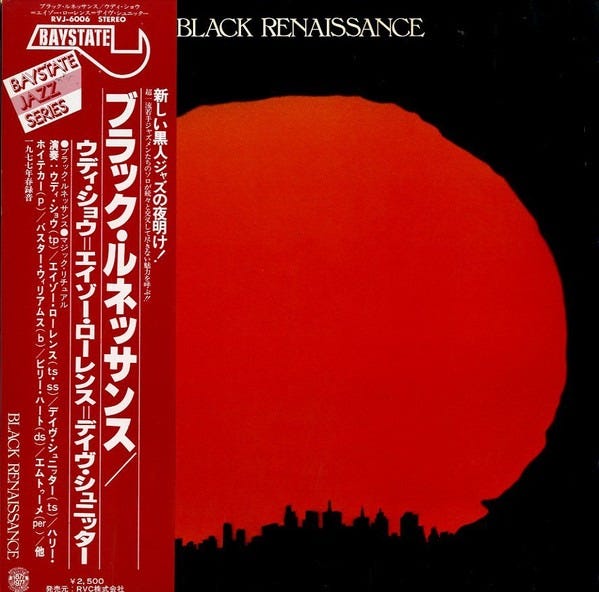
avant-garde jazz
An emblem of all the great lost records out there. The album is credited to Black Renaissance, but it should be to Harry Whitaker, a soulful pianist with an ear for transfixing arrangements. He comes up under the tutelage of Lloyd Price until Roy Ayers hires him for his band Ubiquity at the turn of the 70s. That’s Whitaker putting together the pieces of “We Live in Brooklyn, Baby.” Eugene McDaniels utilizes that ear for the nigh-impossible-to-define Headless Heroes of the Apocalypse, where Whitaker catches the attention of Roberta Flack. She steals him away for her mid-70s peak as the indisputable queen of late night soul music. Now a man of the scene and with the funds to produce his own album, Whitaker books a studio on January 15, 1976, MLK Jr.’s birthdate. No charts, no rehearsals, no gestation period, just Whitaker’s friends—Woody Shaw, Billy Hart, Buster Williams, Mtume, Azar Lawrence, and a whole mess of others—and ideas about the energy he wants to capture. From the two extended tracks, each recorded in one take, that energy is a celebration of Black music, particularly the post-bop jazz sound, increasingly throughout the decade, pushed outwards toward the vanguard and pulled inwards toward soul. You get moments of funk, moments of proto-rap, moments of harmonic groove, moments of African rhythm appreciation, moments of spiritual squawking, and moments of multicultural expansion. The music swirls around you in a hurricane of jazz feeling and community. Japanese imprint Baystate produces the record and releases it in 1977 without informing Whitaker, who does not properly benefit until Luv N’ Haight reissues it in 2002. There is a lot more story, most of it unfortunately difficult. One wonders how many other lost albums like this one are/were out there; at least we are lucky enough to have this one in our lives.
Interestingly, for the album cover, Baystate gives NYC the rising sun they know so well. It works, if not particularly inspiring.
Cheap Trick - Cheap Trick (Epic)
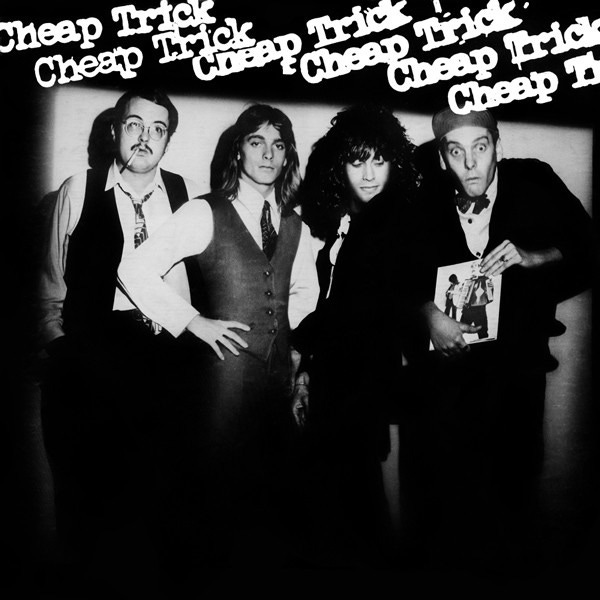
hard rock
Cheap Trick makes hard rock for those who are paying attention. Meaning, between arena-worthy riffs, there is quite a lot to like: the lyrical subversion, the ear for the contemporary (meaning punk and new wave’s rise in popularity), the clever uses of melody. They know how to write songs that get you bopping as well as stick in your craw. The debut from the Midwest quartet is a little like what Big Star may have sounded like if they recorded their seminal albums during the second half of the 70s rather than the first. You get an appreciation for 60s pop-rock hooks and the Who’s early-70s amping of the stakes. But you also get a recognition of the increasingly sleazed-out fun of Aerosmith and the sharp riff edges coming from beneath the mainstream. Most importantly, though, is the idiosyncrasies of Rick Nielsen’s songwriting. He uses the noise of his band to tell stories of suicide (“You say you never / Realized how much you were suffering”), pedophiles (“Ah, I’m thirty but I feel like sixteen”), selling out (“I’d do anything for money / Look at the things that I write”), and America’s great societal concern of the next half-century (“I was a lonely boy … I need a girl to gimmie some love … I need a knife to get me a wife … I need a gun to have some fun … And why you fight it I just don’t know”). It is not a blueprint for arena rock because it is too smart. Instead, it is a seed of alternative rock. It is the loud-quiet-loud without the quiet. You just have to pay attention to what is going on among the blaring riffs.
The boys forefront the humor on the album cover. You get the cliche-looking rockers in the center, but also the reality on the edges. It immediately makes them distinctive. It is a well-conceived piece of jacket art.