Building a Record Collection: 1978 - Ain’t Living Long Like This thru Chairs Missing
Rodney Crowell | The Jam | Chic | The Cars | Wire
I’m building my dream record collection. Thirty albums from each year between 1960 and 2020. Five albums per post, one year per month, a round-up of other notable records before I move on to the next. I want to build a personal music collection like a small library of modern art, one in which the album is the medium. You can read my complete thinking here, including links to other entries.

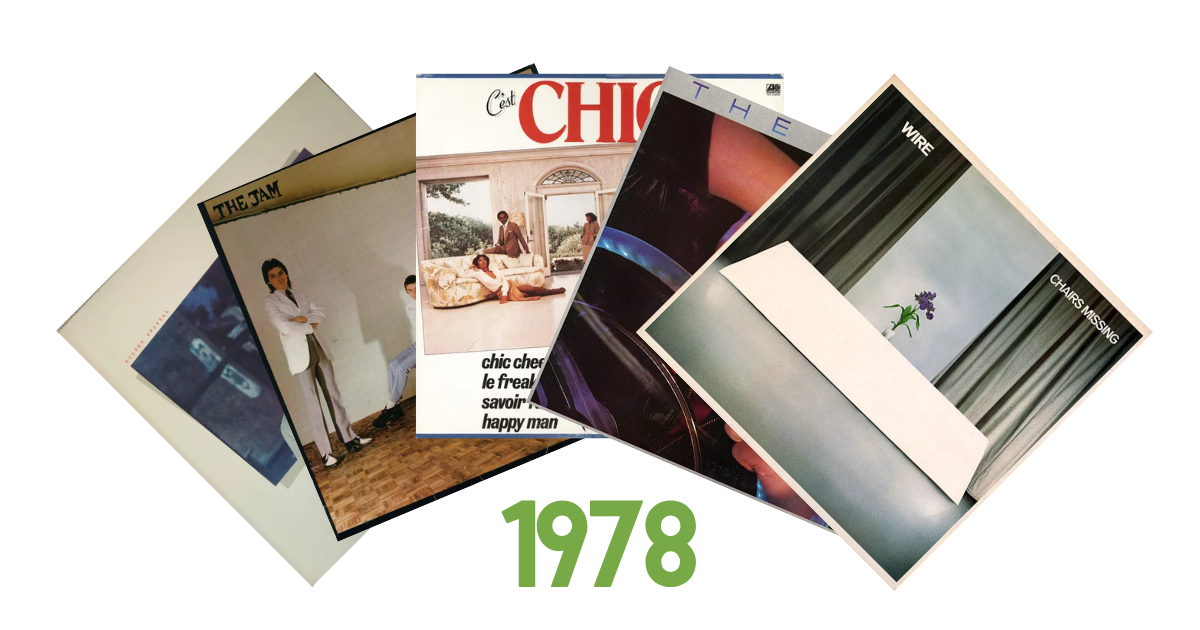
The year is 1978. The Sex Pistols play their final show; Sid Vicious is charged with the murder of his girlfriend Nancy Spungen. The Saturday Night Fever soundtrack stays atop the Billboard charts for six months. “Y.M.C.A.” is a phenomenon. Kate Bush becomes the first female songwriter to top the UK singles chart with “Wuthering Heights.” The Blues Brothers debut on Saturday Night Live. The film version of The Wiz, starring Diana Ross, Michael Jackson, and Lena Horne, is released. Keith Moon overdoses on prescription drugs. Sandy Denny and Louis Prima each die of cerebral hemorrhage, Jacques Brel of lung cancer. The U.S. Postal Service releases the first stamp in its long-running Performing Arts Series: of the “Father of Country Music” Jimmie Rodgers.
See all of the 1970s selections
See all selections listed by artist

1978
Part 1
Listed alphabetically by album title
Rodney Crowell - Ain’t Living Long Like This (Warner Bros.)
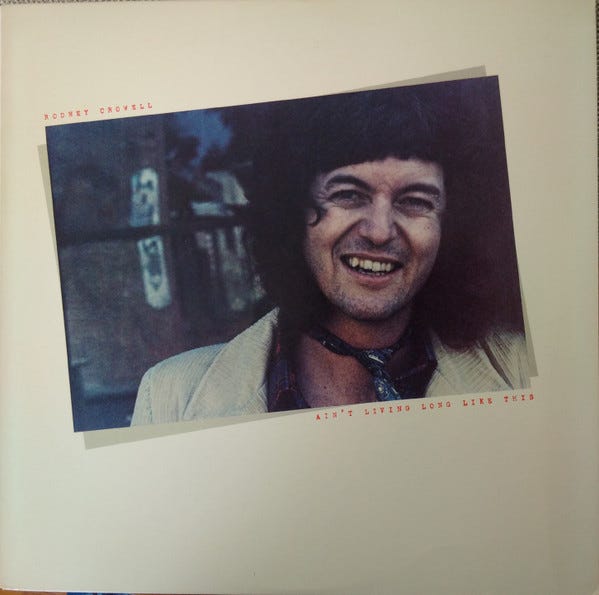
progressive country
Crowell steps out from the shadow of Emmylou Harris. He might as well be stepping into the hole left by her close friend, the late Gram Parsons. Crowell has that same innate soulfulness to his delivery, filtered through a similarly warm country-rock band sound and lingering pathos. But where Parsons comes up in California, Crowell is a Texas man. Meaning, he is taking cues from songwriters-extraordinaire Guy Clark and Townes Van Zandt. Crowell brings this poetic twang to Harris’s Hot Band in the mid-70s, and quickly becomes one of her go-to songsmiths. Soon enough, he is ready be up front himself, and this debut sets the momentum for a long solo career. Ain’t Living is clever and catchy, relaxed and insightful, outlaw without being rebellious, progressive in the sense that it is mixing Bakersfield with the lyrical Texas bards. And if the company one keeps is any indication of talent being recognized, check the liner notes: Harris, Ry Cooder, Dr. John, Willie Nelson, Ricky Skaggs, Hal Blaine, James Burton. The group can swing with the energy of a honky tonk band raised on old school R&B or sit back in a modern rock groove, depending on the tune. It leads to a sound that is a bit lost in time: the 80s-country blueprint of “Baby, Better Start Turnin’ ‘Em Down,” the country-folk balladry of “Song for the Life,” the rockabilly of the title track, and the wait-do-I-like-Jimmy-Buffet? of “Voilá, An American Dream.” Yet, despite this diversity, the album still coheres, much thanks to the excellent musicianship and strong songwriting. It is also no wonder that the self-penned tracks here find many afterlives for other musicians. A hell of a first attempt for Crowell, and a preview of the long, fruitful career to come.
Who is in charge of design at Warner Bros. these days? Do they have a vendetta against Crowell? Why is his name so damn small on the album cover? What a failure of jacket art! So disrespectful of the music.
The Jam - All Mod Cons (Polydor)
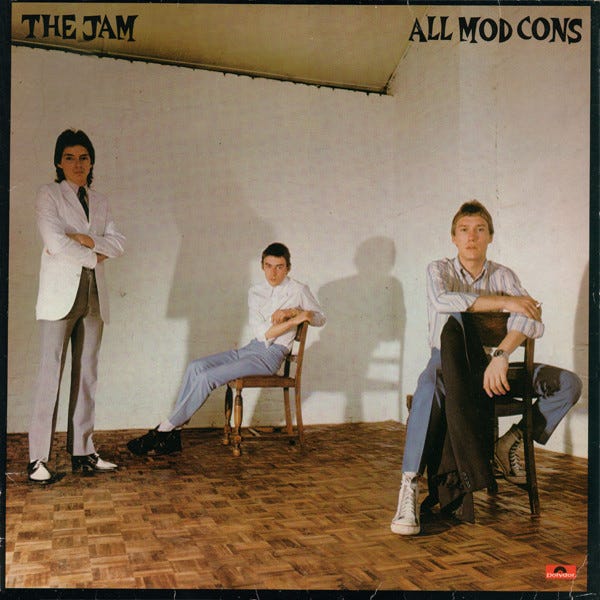
mod revival
The dreaded “voice of a generation” tag. This time, Paul Weller gets saddled with it. Well, in Britain at least, as the Jam are distinctly of Her Majesty—from the audible accents to the rejection by American audiences to the whole-hearted embracement of the Who and 60s mod culture as a starting point. The trio even double-down on the inside-out perspective by faithfully covering the Kinks’ “David Watts” on this, their third and most successful LP to date. How else to read all of it other than a telegraphing to listeners that they should be understood as the next in the lineage of smart, social-commentating British pop-rock bands? And the boys are right. All Mod Cons is smart, and it is catchy, and it is very mod. But it is also produced in the context of the punk explosion. So, the R&B scaffolding is stripped down to mostly great basslines by Bruce Foxton, while drummer Rick Buckler attacks with more of a punk-rock aggression. That leaves Weller to focus on character development, his songs much more now in the vein of Ray Davies rather than the Pete Townshend of the previous records. His guitar, in fact, is almost an afterthought; it shades instead of leads, which gives the songs more of a new wave vibe than a power pop one. But back to the “voice of a generation.” The album closes with “Down in the Tube Station at Midnight,” their best-charting song in the UK thus far. A swingless beat, bopping bassline, and some simple guitar noises. But urging on the tempo, there is the audible anxiety in Weller’s words: “I first felt a fist / And then a kick / I could now smell their breath / They smelt of pubs / And Wormwood Scrubs / And too many right wing meetings.” Now that is storyteller’s detail. A lyricist of specificity and place. Of the senses. A voice. And one that many-a stylish young Brit can relate to and gather toward.
I don’t like the typography of the album jacket, but I love the symbolism of the rest. They play with the term “mod” they know they are going to get. So they flip it with a real estate Britishism, and then literally show the emptiness of both readings of the word. Smart kids.
Chic - C’est Chic (Atlantic)
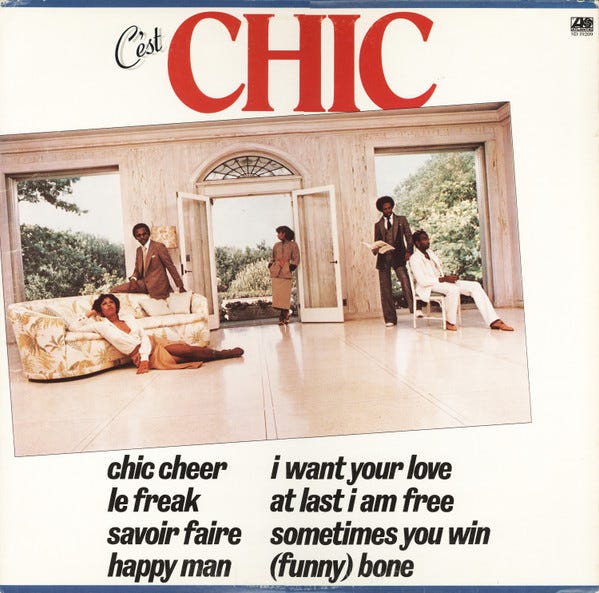
disco-soul
The disco album. If you only have one—and, by all means, you should have more than one, unless, I guess, you don’t like fun—then C’est Chic is the one. It exemplifies the genre: the preeminence of the groove, the vogueable hooks, the glamorous tonal colors. It is a continuous smile from beginning to end, whether a dancefloor-illuminating beam or a candle-dim sexy smirk. Bernard Edwards’s bass out-performs everyone. It has a durable elasticity, as stretchable as it is snappable, each string a flexing hamstring you want to sink your teeth into. Niles Rogers is more of a chucking workhorse, the provider of textures needed for a quality disco bop. That said, he does get to stretch out some on the quiet storm ballads, most notably “Savoir Faire.” “Le Freak” perhaps only rivals “Stayin’ Alive” as the genre’s exemplar, which of course drips with irony as it is written in response to Edwards and Rogers being rejected from entering Studio 54 on NYE 1977. Sing it with me now! “Ahhh, fuck off!” And of course, there is the studio genius of “I Want Your Love.” More lush and sweeping and relaxed than “Le Freak,” it makes excellent use of Alfa Anderson as the narrator and is a best-case-scenario of tubular bell accents. The album as a whole winds you up and releases the tension. It is the prep, the party, and the heavy petting that follows. And it is only the beginning of Edwards and Rogers’s influence on pop music. There is much fun still to be had.
The big question with this album cover: tracklisting on the front? Never my favorite. And with such a great jacket photo to take advantage of! Maybe the horizontal dimensions of that photo meant there was too much negative space left for the designer’s liking. I’d rather have more of that marble than the names of the songs.
The Cars - The Cars (Elektra)
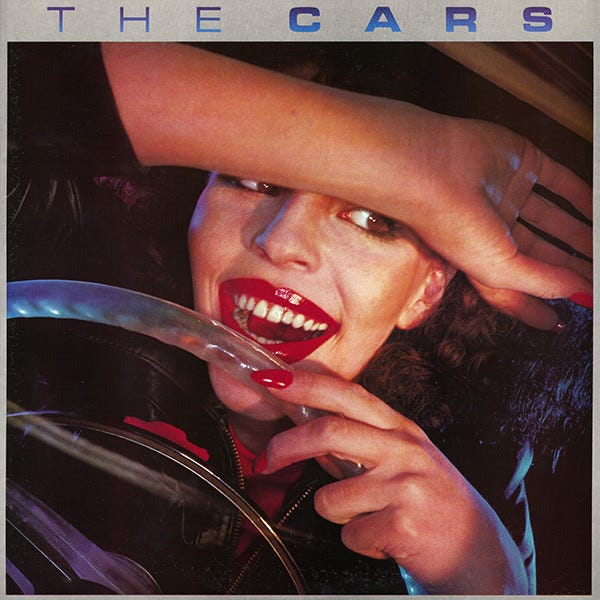
new wave
New wave is introduced to mainstream rock radio. It all starts with “Just What I Needed,” appropriately. The Rick Ocasek-penned song leads a demo tape recorded by the newly formed Cars in 1977. Ocasek and bassist Ben Orr had been looking for the right mix of players and sound for the entire decade. They traverse folk-rock, proto-punk, and jazz-rock before finding their niche: arty new wave revved up with power pop. A Velvet Underground foundation, a Roxy Music ironic detachment, and a Queen sheen. Local Boston radio loves “Just What I Needed”; it’s angular pop gyrations blown-out with classic rock riffs and a sing-along chorus. Major labels quickly come a’knockin’, and the band, now backed by former Modern Lovers drummer David Robinson enter the studio with Roy Thomas Baker. They embrace the sound of cutting-edge technology and lean into pristine production, each sound isolated and sparkling. Ocasek can write a pop hook with the best of them, and Baker throws the kitchen sink at each: synths, sound effects, exponentially multi-tracked vocals. It is a technician’s dream record as much as it is for a teenager trying on bold primary colors and geometric hairstyles. And, amazingly, it also pleases the growing paunches controlling AOR radio. They forgive the keyboards for the ample guitar riffs. It is a practical Venn diagram of 1978 mainstream music interests. Thanks to this starting line sprint, the Cars will be the heuristic for new wave for the next decade.
The band hates this album cover. They want something artier, something that speaks to their underground cred. Elektra wants the face of a Russian model. The label wins, as they do, and we get a smile that graces the floor of every teenage bedroom from Boston to Los Angeles in the late 70s. In retrospect, it gives off David Lynch vibes to me, like the creepily exuberant elderly couple in Mulholland Drive. Using that perspective, I’m in.
Wire - Chairs Missing (Harvest)
art-punk
The art evolves. 1977’s Pink Flag embraced punk’s minimalist take on rock, and then took it a step further. Wire deconstructed even the emotional catharsis inherent in the genre, opting to use compositions as intellectual exercises in a typically feeling-first music. Chairs Missing signals a band now ready to add some of that emotion back in, but via the particularly rebellious personality of its members. Now the album employs sporadic pop hooks, warm ones even, which is notable for a band known for their frosty distance from your eye-rolling need for release (meant empathetically, of course). Side one ends with “Heartbeat,” a bass-driven pulse of a song that is a bit of a mantra: “I feel empty / I feel dark / I remark / I am mesmerised by my own beat / Like a heartbeat.” Then you flip the record over, and something changes in the London boys. “Mercy” doubles their normally fragmented song length, presenting a case for a noisy rock sound that is outside psychedelic freak-outs. Is that you, post-rock? Alternative rock!? Then, the jaw-dropping “Outdoor Miner.” Chiming, melodic, catchy, hugging. Did Wire just write an indie-pop ditty!?! Finally, “I am the Fly,” which is a rebuttal of the immediately previous approachable sound. Weirdo reverb and a biting accent by Colin Newman: “I am the fly in the ointment / I can spread more disease than the fleas.” Clap along everyone! It is a perky stick to the eye. Wire’s songwriting, both lyrically and musically (which is notably enhanced by producer Mike Thorne’s clever use of space and unexpected sounds), has matured considerably in just a year. More diverse, more crafty, more subversive. They are like a bacteria that evolves rapidly to attack their host, and that is among the greatest compliments you can give to reactive art.
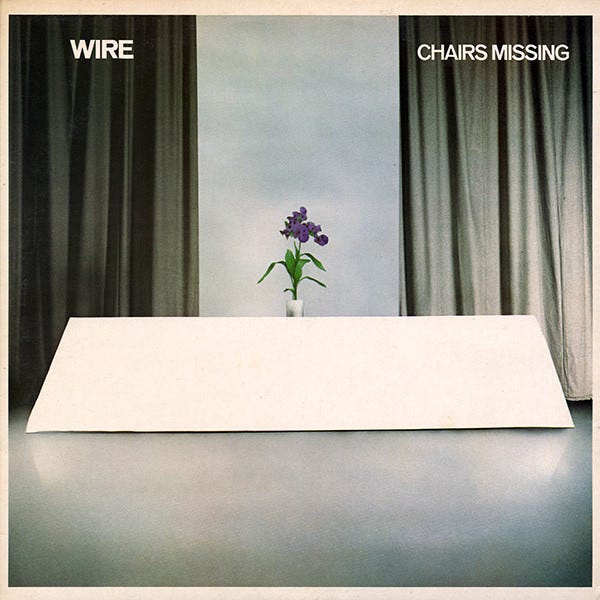
Having a few “chairs missing in the front room” is a Britishism for being disturbed. (I had to look it up as an American.) The album cover presents a table with no chairs. Just a lovely bouquet in an otherwise colorless room. Perhaps, a beautiful idea in an otherwise unsettling mindset? Very visually clever.