Building a Record Collection: 1979 - 154 thru The B-52’s
Wire | Throbbing Gristle | Brian Eno | Elvis Costello & the Attractions | The B-52's
I’m building my dream record collection. Thirty albums from each year between 1960 and 2020. Five albums per post, one year per month, a round-up of other notable records before I move on to the next. I want to build a personal music collection like a small library of modern art, one in which the album is the medium. You can read my complete thinking here, including links to other entries.

The year is 1979. Disco, and particularly Donna Summer, dominate the Billboard Hot 100. At least until “My Sharona” signals a return to rock. The “YMCA dance” debuts on American Bandstand. Disco Demolition Night… yeesh. Digital recordings begin in earnest. The Sony Walkman goes on sale in Japan. “Rapper’s Delight” is the first rap single to be a Top 40 hit. Critic Geoff Barton coins the “New Wave of British Heavy Metal.” Bauhaus releases “Bela Lugosi’s Dead,” the first goth-rock single. Ronnie James Dio replaces Ozzy Osbourne as the frontman of Black Sabbath. Jello Biafra establishes Alternative Tentacles, creating a home for West Coast punk. Charles Mingus and Lester Flatt die. Minnie Riperton succumbs to breast cancer, Stan Kenton to a stroke. Sid Vicious is found dead from an overdose. Donny Hathaway falls to his death from a high-rise hotel room. Kate Bush, the first artist equipped with a wireless mic, tours for the only time in her career.
Part 3 (coming Jun 10)
Part 4 (coming Jun 14)
Part 5 (coming Jun 18)
Part 6 (coming Jun 23)
Other notable records (coming Jun 27)
See all of the 1970s selections
See all selections listed by artist

1979
Part 1
Listed alphabetically by album title
Wire - 154 (EMI)
art-punk
The witty idea-generators are out of runway. That is certainly not a slight against this record, their third in as many years. It is just that this will be their last recorded statement as a band for a while. That’s because the London quartet aren’t here for the lifestyle; they are here for the art. Pink Flag uses punk parameters to explore intellectual ideas. Chairs Missing evolves this sound, injecting more emotion and atmosphere. The third of art-punk’s codifying trilogy, named after the number of shows it takes to get to this iteration, is pressurized texture. The band is more studio than ever. They leverage production tools to further crystalize these musical ideas. That is meant less in the conceptual definition of the verb, which suggests clarifying, and more in the physical sense of it, i.e. the nucleation of musical molecules into these oddly-shaped, ice-cold, sonic-pattern gemstones. The guitar and bass tones practically have blue-tinted vapor clouding off them. On songs like the seven-minute “A Touching Display” (such a length would’ve seemingly been anathema to the Wire of 1977), you easily lose track of which instrument is which as each produces shifting glacier-like groans and scrapes. Graham Lewis now joins Colin Newman as co-frontmen, and both deliver charismatic performances. The music particularly glistens when they share the mic, whether in harmony (the fantastic post-punk pop tunes “The 15th” and “Map Ref. 41°N 93°W”) or in opposition (the nervous inner-thoughts of “40 Versions”). The band, rightfully it should be said, wants to promote this next evolution in theaters and with “left-field TV adverts,” as Newman explains to Trouser Press in 1981. But EMI doesn’t get it; they want to go traditional. Heads butt, Wire loses the platform to present their ideas, and thus go on hiatus. Why waste this creativity on labels that aren’t forward-thinking enough to go along? Don’t worry though; the boys will be back. There is much ideation left to do.
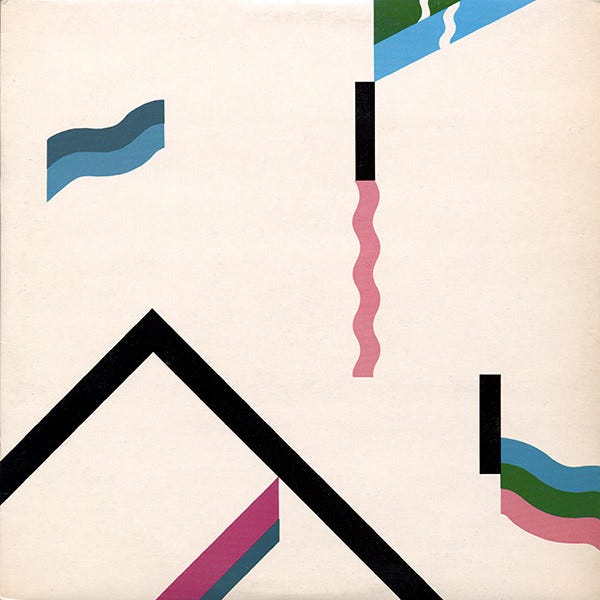
The album sleeve uses a design conceived by Lewis and guitarist B.C. Gilbert. I like to think of it also as an evolution of the previous two records: the pink flag draping in the center, the chair-less table on its side in the bottom left-hand corner. My reading is almost certainly not the intended one, but this just goes to show how Wire gets you thinking while listening to their music.
Throbbing Gristle - 20 Jazz Funk Greats (Industrial)
experimental synth-pop
A subversive step into accessibility. What else would you expect from industrial-innovators Throbbing Gristle? A compliant step into the space of normies? Please. Just a couple of years after being labeled the “wreckers of civilisation” by a British Parliamentarian (thanks for bringing in the audience, bro!), the self-described “post-psychedelic trash” band now need to swerve from the expectations of their noise-loving fans. They turn to rhythm machines: the DR-55 “Dr. Rhythm” drum machine, the CSQ-100 sequencer, the System-100M modular synthesizer. To characterize it another way, Roland and Boss equipment that could be used by Giorgio Moroder or Kraftwerk to create technicolor synth-pop soundscapes. But in the hands of Throbbing Gristle? The electronic sounds begin to fester, as if they’ve achieved an organic nature. The album’s centerpiece, “Hot on the Heels of Love,” features a dancefloor beat that is sexualized by Cosey Fanni Tutti’s fawning whispers. Amid the melodic pulsing, though, a whip panned hard left, so sharp that there is no question it breaks skin. This is certainly proto-techno and previews all the wondrous directions electronic music will take, but it also leads directly into “Persuasion,” a sinisterly throbbing (sorry, I couldn’t think of another adjective) song with an unsure rhythm. Vocalist and bassist Genesis P-Orridge calmly narrates how he is going to convince you to participate in smutty photos as tape loops trade drill-like guitar noise and confusing human sounds (is she having fun or in painful distress?). And then? How about the cleverly programmed, medicinal synth-pop of “Walkabout,” inviting and dreamlike. This is the sound of schizophrenia, delivered without melodrama. Everything looks totally normal on the outside, but as soon as the door closes and the lights go off…
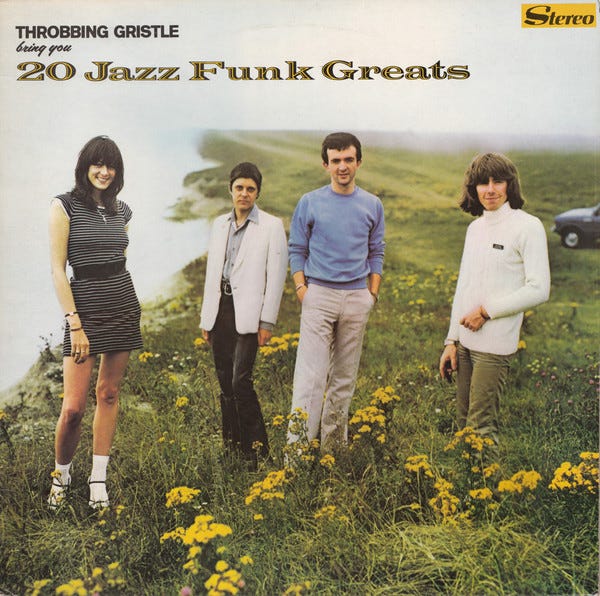
Speaking of looking normal on the outside, the band, in their genius troublemaking glory, take a photo that would fit nicely in a “Woolworth’s bargain bin.” But they do so in front Sussex’s Beachy Head, a notorious suicide spot that employs a team to patrol the area every evening to locate and stop potential jumpers. Now that is some subversion.
Brian Eno - Ambient 1 (Music for Airports) (EG / Polydor)
ambient
It is not the invention of ambient music; it is the establishment of a popular ambient genre. The idea of ambient music—a demotion of familiar song structure and rhythm so to place the emphasis on tone and, especially, atmosphere—has been around at least since musique d’ameublement, as coined by Erik Satie in the early 1900s. This “background” sound evolved in a number of ways: musique concrète, minimalism, new age, early Krautrock, whatever John Cage is, slow-motion prog, dub, and, most sinisterly to many, Muzak. The latter’s doubled-down diluting of non-offensive music to fill space without eliciting response is anathema to a mind like Eno’s, wont to consider how sound affects the physicality of life. So, he begins to see public spaces as relative art installations and wonders how to “tint” them sonically so that there is a stimulus to otherwise numbing environs. Think of it as opportunity for momentary enlightenment. Music for Airports is the first entry in this effort, a series dubbed “ambient,” memorably described as “like New Age gets an MFA” by J.D. Considine. Eno makes it out of tape loops: a piano phase by Robert Wyatt, synthesizer swells, slowed vocal coos, warmingly controlled feedback. It is built mechanically but presents itself emotionally. It is sound designed to be ignored until it isn’t, at which point it allows you to feel the enormity of your physical space. It is not thinking music as much as it is feeling music, and few do it better than Eno.
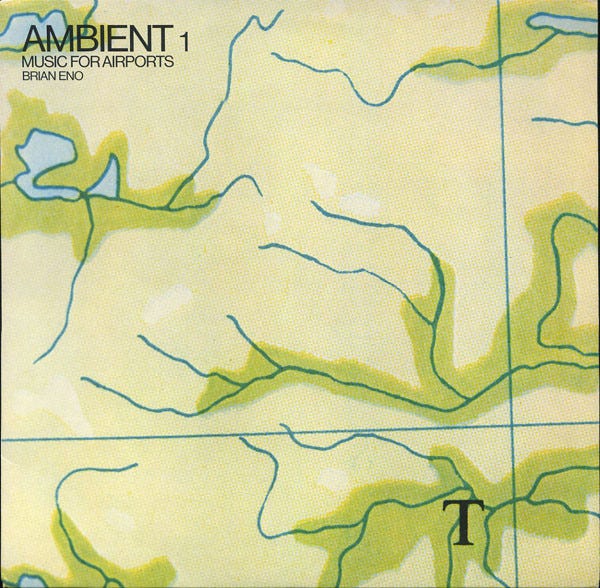
Interesting that the album cover brings you into the actual airplane, now far above the landscape, rather than keep you in the airport, where it is designed to be played. For that, I feel it is kind of a missed opportunity. A fitting one for the music, certainly, but perhaps not for the original idea.
Elvis Costello & the Attractions - Armed Forces (Radar)
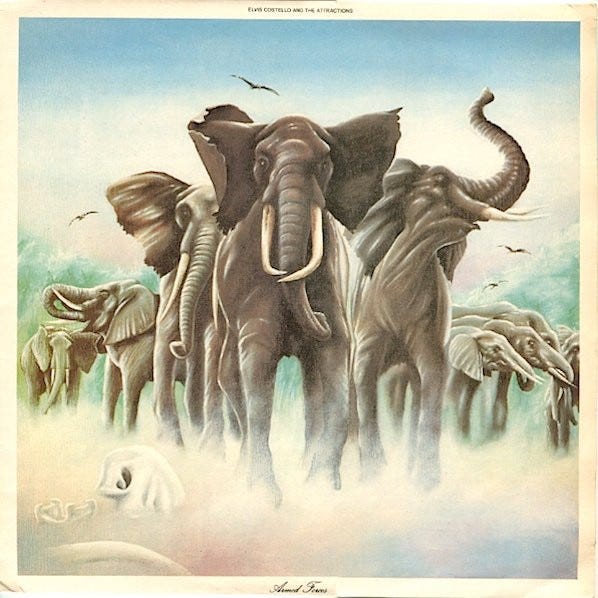
pop-rock
Costello begins to shed his punk roots. With the adoption of the Attractions as co-pilots on 1978’s This Year’s Model, he jets toward new wave. Now even that angular landscape gets smoothed out. Maybe it is the continued Nick Lowe influence. Maybe it is just Costello gravitating toward his pop songwriting instincts and away from the style-of-the-day. Regardless, there are few auteurs out there better fit for combining rock’s motoring backbeat and pop’s insistence on a catchy melodic hook. Armed Forces is confidence on wax, the unwavering belief of lyrical cleverness. So, Costello takes a military metaphor for relationship contention and stretches it across 12 songs. They even play with titling the record “Emotional Fascism.” It is charged, combative, smirking, and perhaps a tick or two too gimmicky. (Costello’s nonchalant use of racial language has decidedly not aged well, for example.) It is also self-aware and cleverly constructed. Both Costello and the Attractions recognize their powers and then maximize them. Rather than edit the dense songwriting, they produce melodic rock songs that are equally detailed and emphatically performed. This is a level of sure-footed craft that demands appreciation and rewards in-kind. You can dive into the politics of Costello’s narratives or just bop along to how they are delivered. Punk of course does the same, but pop-rock, and particularly that of the Costello-Attractions-Lowe triumvirate, can make it even more devious. Cynicism that goes down easy.
The original UK version of the record features the postcard-like painting of stampeding elephants. You, as the viewer, are standing in the path of kitschy doom as the herd parades closer. The U.S. version puts a colorful drip painting on the front. More impressionistic, less sardonic. For that reason, gotta give it to the UK version for being the more apt artwork.
The B-52’s - The B-52’s (Warner Bros.)
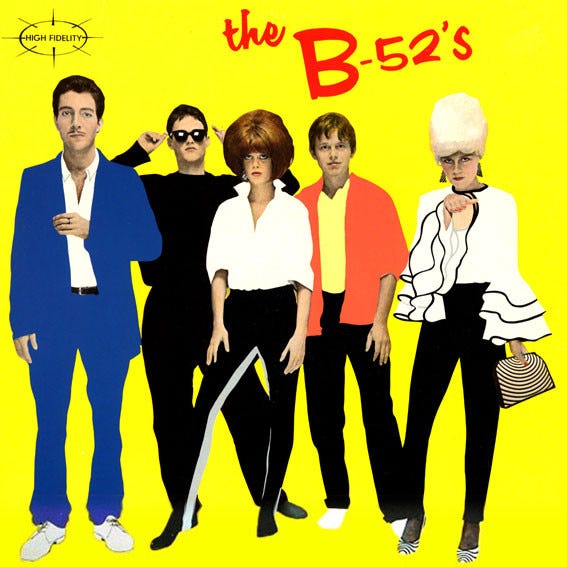
new wave
The South produces camp icons. This is what conservative cultures do. They squeeze young creatives so much that the pressure produces a diamond. It starts before new wave is upon us, in 1976, appropriately with flaming volcano drinks. Friends with imaginative impulses who are bored. They pool musical interests, mostly coming from before the Beatles codified pop-rock: surf, 50’s pop, early Southern funk, kitsch sci-fi soundtracks, sock-hop dance. They learn instruments enough. They hit up thrift stores for a look and pile the hair as high as it will go. Those beehives, in fact, seem to encapsulate it all: the turn of the 60s, bigger is better, dramatic gestures, elaborate glamour for the sake of being glamorous, the name of the band. And then, “Rock Lobster,” a baritone-tuned surf guitar line, Farfisa organ, drums, and vocals so ridiculous you can’t help but join in the fun. Perfect timing too. The fashionable (Blondie) and the quirky (Talking Heads) are contending with punk’s agita as the hip sound for the college crowd. So the B-52’s get nabbed by the majors, head to the Bahamas to record with Island’s Chris Blackwell, and put their kitsch-punk to tape. It’s raw but irresistible, something to dance to but also something to emulate. A queer correction to the increasingly testosterone-filled direction of leather-clad underground rockers. Thank Athens, Georgia, a progressive enclave surrounded by resistance to change. It produces a sound every downtown scene will be bopping to for the next decade.
Thanks to the Island connection, the UK label that produces the record and releases it overseas, Warner gets album cover designer extraordinaire Sue Ab Surd for the jacket. This is the same person responsible for all your favorite reggae record covers. You can tell he feels the music, celebrating its cartoonishness. The “high fidelity” logo! Just the right kind of throwback signaling and a good balancing image. Great stuff.