Building a Record Collection: 1973 - Lonesome, On’ry and Mean thru Outside the Dream Syndicate
Waylon Jennings, MFSB, New York Dolls, Paul Bley, and Tony Conrad & Faust
I’m building my dream record collection. Thirty albums from each year between 1960 and 2020. Five albums per post, one year per month, a round-up of other notable records before I move on to the next. I want to build a personal music collection like a small library of modern art, one in which the album is the medium. You can read my complete thinking here, including links to other entries. No one’s musical knowledge is complete, and neither is mine. Please point out my massive gaps in the comment section!
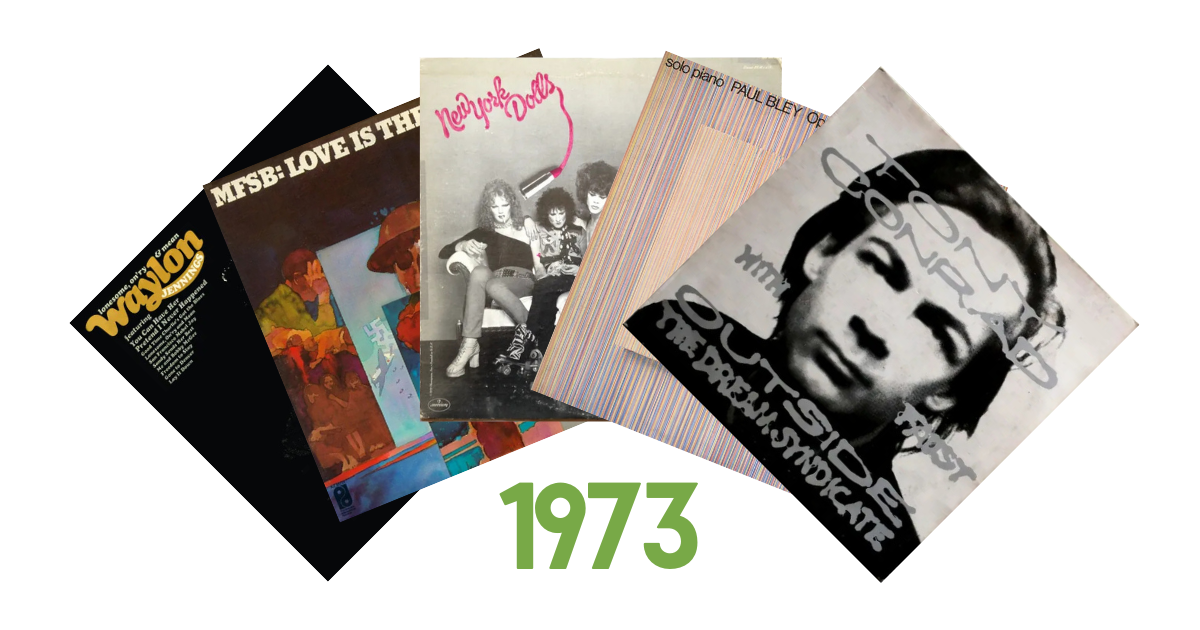
The year is 1973. Albums are delayed due to the 1973 oil crisis causing shortages in vinyl. Richard Branson launches Virgin Records with Mike Oldfield’s Tubular Bells, and Casablanca Records sign Kiss as their first act. CBGB opens in Manhattan; the Roxy Theatre opens in West Hollywood. American Country Countdown debuts. Queen Elizabeth opens the Sydney Opera House. Puerto Rican music promoter Izzy Sanabria hosts the television show Salsa, popularizing the term for New York-based Latin music, particularly of Cuban origins. Led Zeppelin breaks The Beatles record for highest attendance for a concert. Robert Wyatt becomes paralyzed from the waist down after a three storey fall in London. Stevie Wonder spends four days in a coma after a car accident in North Carolina. Sister Rosetta Tharpe, Willie ‘The Lion’ Smith, and Gene Krupa pass; Gram Parsons dies of a drug overdose; Víctor Jara is murdered by the Pinochet regime. DJ Kool Herc isolates the breaks in a couple of hard funk records for a technique called “The Merry-Go-Round,” creating hip-hop in the process.
See all of the 1970s selections
See all selections listed by artist
1973
Part 4
Listed alphabetically by album title
Waylon Jennings - Lonesome, On’ry & Mean (RCA)
outlaw country
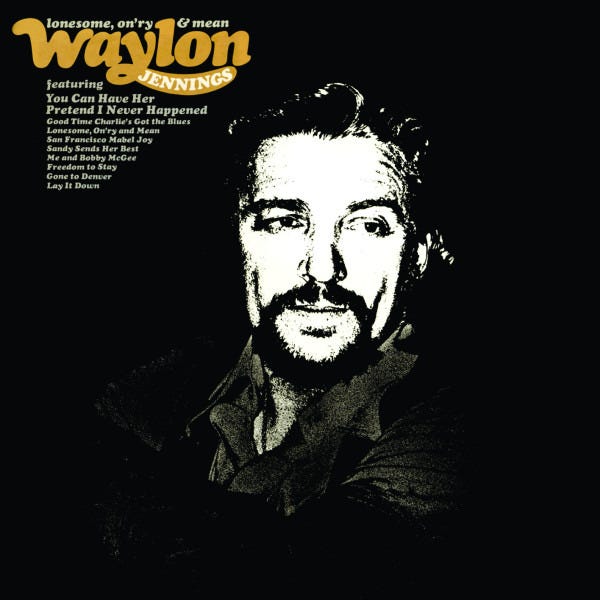
The counterculture comes for country. It certainly was already knocking around, particularly with the progressive country sound of Sweetheart of the Rodeo and its fans, earnest country-rock that evolved out of Bakersfield’s spin on honky tonk and hippie ideals. Now, even longtime Nashville veterans, Jennings and Willie Nelson chief among them, are done with its sclerotic system. The logical conclusion of an arc that starts with 1971’s The Taker / Tulsa finds Jennings with his hair grown out and fighting for complete control of his sound from the RCA honchos. In other words, an outlaw of the man. He gets what he wants, according to his autobiography, thanks to a new manager and a well-timed bathroom break. Now, Jennings’s touring band is in the studio with him and he is handpicking his songs, choice cuts from Nelson, Johnny Cash, Kris Kristofferson, Mickey Newbury, and Steve Young. This is still country, no doubt, but it places the songwriter above audience considerations, emotional resonance over pristine engineering. It allows folk, rock, and blues to rough up the edges of honky tonk and countrypolitan polish. Jennings is an excellent avatar for this new country antihero, as Kelefa Sanneh deems him, much thanks to his perpetually weary baritone. A man clearly coming in from a long journey alone and in no mood for someone to comment on the dustiness of his boots, nonetheless the length of his hair.
What does an outlaw look like? Well, Jennings’s jacket photo is a good start. RCA might be keeping the color to just the great titling of his name to try to hide the length of his hair, but this is definitely not a guy dressed up for the Grand Ole Opry.
MFSB - Love is the Message (Philadelphia International)
Philly soul-funk
The sound of Philadelphia. The sound of Philadelphia International Records. The sound of the many Kenny Gamble and Leon Huff productions. The sound of the equally great Thom Bell arrangements. The sound that engines the O’Jay’s “Love Train.” The sound that lifts Harold Melvin & the Blue Notes, the Stylistics, the Spinners, and Billy Paul into 70s-soul superstardom. The sound you hear at the beginning of each and every Soul Train episode. The sound that prioritizes groove above all else. The sound that forms the blueprint for disco. The sound that Larry Levan will champion at the Paradise Garage. The sound that will eventually spin off into the Salsoul Orchestra. The sound that will be one of the initial inductees into the much-too-short-lived Dance Music Hall of Fame. The sound that makes you want to yell “motherfuckin’ son-of-a-bitch” when the band hits that groove so hard it hurts your muscles not to move. The sound that you explain to your parents is for mothers, fathers, sisters, and brothers. The sound of super smooth and funky 70s soul music.
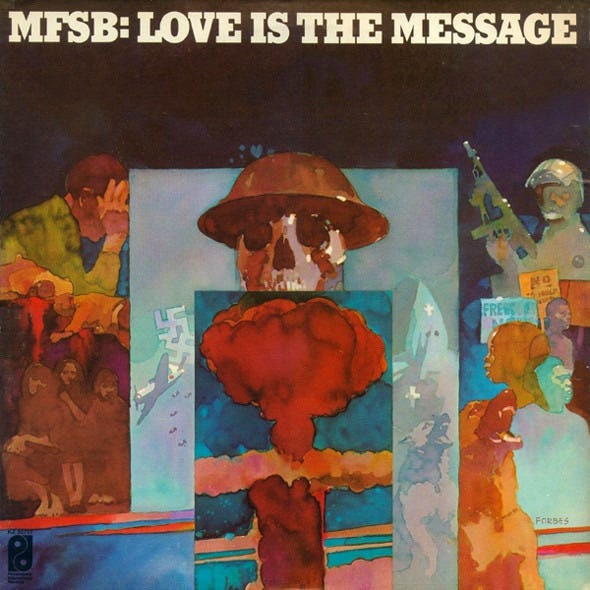
It is quite a political album cover for a sound that is seemingly so apolitical. I suppose the designer is trying to say that love can solve all of these problems, but I think it does the record a disservice. You would never guess the contents of this package just looking at the jacket.
New York Dolls - New York Dolls (Mercury)
proto-punk glam rock
The end point of glam rock is the beginning of something even more culture-shifting. Though, even the glam rock connotation is a little off for these true originals. First, they aren’t British, though the NYC boys do certainly love crunchy guitar rock and bubblegum pop. Frontman David Johansen even quotes the Shangri-Las early on this record, their debut. Second, while T. Rex and David Bowie want to boogie under big, colorful lights, the Dolls are more interested in making noise in dingy clubs, a la the Stooges. Finally, they are less putting on make-up for a night at the theater than they are putting on masks to affront conservative tastes. (Remember, same-sex sexual activity between consenting adults isn’t legal in New York until 1980.) The heterosexual Dolls aren’t interested in sex, however, as much as style, stardom, and sass. They get there through the wonderfully curious choice of a producer, the pop-rock savant Todd Rundgren, who melds their irreverent attitude to their love of Eddie Cochran, the Rascals, girl groups, and the Stones in full hedonism mode. Johnny Thunders’s guitar blasts one noisy hook after another, Johansen yells with a range that starts with snotty and ends with croak, and drummer Jerry Nolan nailguns it all together. Rundgren’s production is fantastic, odd effects adding sounds that rival the curiosity of just about everything else. And it is all so damn catchy. It is the sound that will inspire punk in a few years and hair metal not long after. It is a cultural earthquake, splitting the sophisticated mountain of rock being built by the proggers and letting out all the steam of young folks in need of an outlet for creativity but lacking the money to pay for music lessons.
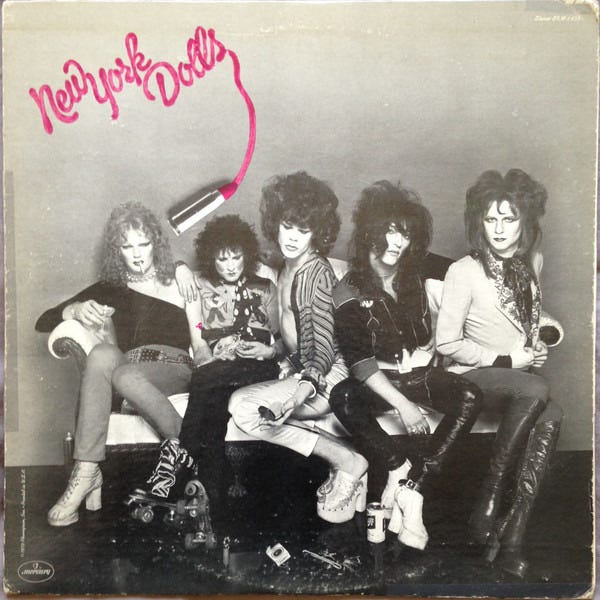
Shock value is the point, remember, so the Dolls in full glamor is the only jacket photo that makes sense. Leaving the lipstick as the only piece in color is a stroke of genius. A perfect package for the record.
Paul Bley - Open, to Love (ECM)
pointillism jazz
Sustain and silence are harmonic tools as well. Bley knows this better than most anyone. The Canadian pianist is 20 years into his career, having the good timing to be a young musician in the early 50s and the good sense to follow modernizing jazz through its incarnations, sitting in with everyone from Chet Baker and Lester Young to Ornette Coleman and George Russell. Following experimentation with synthesizers, Bley is back at the acoustic piano, lured by ECM to follow in Chick Corea and Keith Jarrett’s footsteps and produce a solo record. Bley is even more primed to explore atmosphere than his labelmates, especially considering the sparse, tonal exploration recordings he made with Jimmy Giuffre a decade before. He takes compositions by his ex-wife, the immensely imaginative Carla Bley, and his current wife, the avant-gardist Annette Peacock, and peers into their DNA, admiring the helix shape of the melodies and restacking the harmonics to see how they work. Bley sustains notes until just before complete evaporation, letting oncoming silence be a mechanism for tension. Melodic ideas are proposed and abandoned, consonant harmonies given just enough dissonance to evoke those sweetest of bittersweet memories. There is a poetry to the timbral placement. Nothing is rushed and nothing is forced. A narrative, even if only personal, emerges from echoes of notes and the space between them. It is as compelling as it is patient, and it is haunting as it is present with each play through.
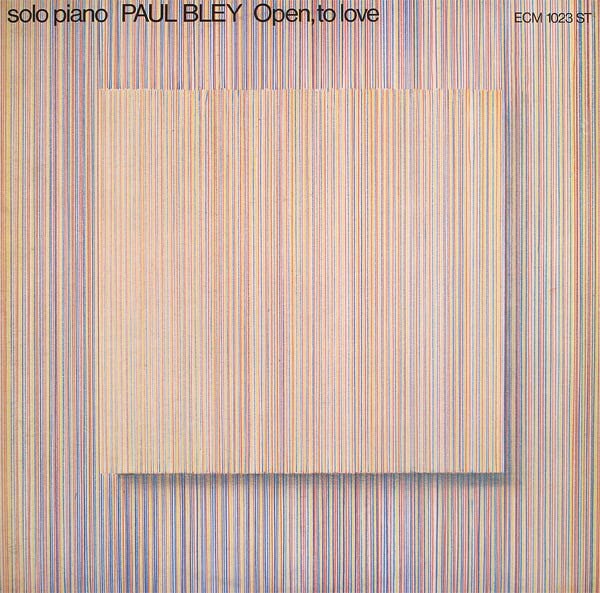
I love the album cover design by Barbara and Burkhardt Wojirsch. Barbara, in particular, has many fantastic designs in the ECM catalogue, but this may be my favorite. It is such a perfect encapsulation of the music. I’d hang this on my wall.
Tony Conrad / Faust - Outside the Dream Syndicate (Caroline)
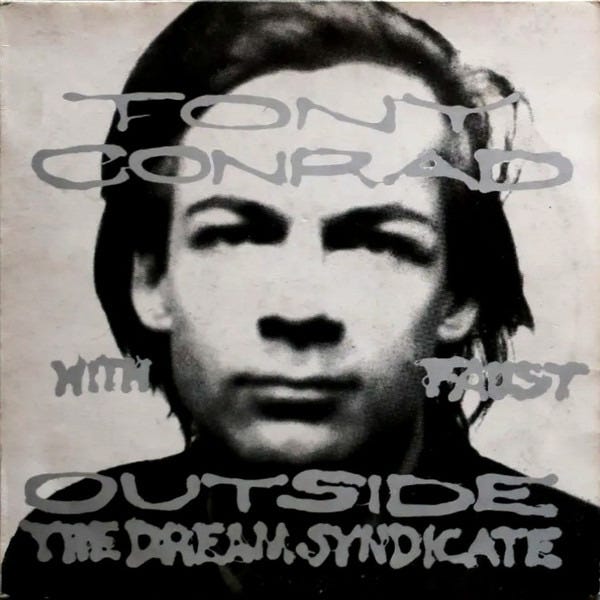
minimalism
American drone meets German Krautrock. Experimental filmmaker and professor Conrad first emerges in the mid-60s New York City avant-garde scene. He is a member of the Theatre of Eternal Music, aka the Dream Syndicate, alongside La Monte Young and John Cale, noise-makers interested in improvisation, drones, pure harmonic intervals, and their effect on the listener. Cale, of course, goes on to put the underground in the Velvet Underground (as well as a varied musical legacy), and Young spends his career chasing the nirvana of minimalism. Conrad, instead, goes to Germany and hooks up with Faust, an art collective whose tape loop experiments helped build Krautrock’s motor a couple years prior. They record for a few days in a schoolhouse, Conrad extending notes for a half-hour at a time, using subtle changes in bowing technique to affect the droning signal. The boys of Faust add division. On side one, a steady bass drum-hi hat march, a single bass note tromping along, the occasional cymbal break to remind the listener to let go of those lingering thoughts and refocus on the breath. Side two is more varied though just as transfixing. It feels like a pre-battle ceremony. The bassline pumps, the drums groove at quarter-pace, distortion fields rise and fall while Conrad plays with the analog phasing effects created by his cycling violin. Blood pressure rises as the track progresses, and by the end, despite the barely perceptible tempo increase, your eyes are red with intent. It’s neither dream nor nightmare music. It’s something in between, something in the Earth’s natural electric field, a plane that exists between the atmosphere’s positive charge and the surface’s negative. Imperceptible but always moving. Constant minimal change.
This is a terrible album cover. No idea why this was chosen or with what intent.